In the world of computer networking, IP (Internet Protocol) addresses play a role similar to “house numbers” on the Internet, helping devices identify and communicate with one another. For more than 30 years, IPv4 has been the fundamental foundation of the Internet. However, with the rapid expansion of the Internet and connected devices (IoT), IPv4 has gradually revealed its limitations, particularly in terms of address availability.
That is precisely why IPv6 was introduced – a new solution that expands the address space, enhances security, and optimizes network performance. In this article, I would like to explore IPv6 in greater depth with you, from its concept and structure to its advantages, challenges, and real-world applications.

1. What is IPv6?
IPv6 (Internet Protocol version 6) is the latest version of the Internet Protocol, designed to replace IPv4. It is responsible for defining how devices communicate over a network and ensuring that each device has a unique address to send and receive data.
History of IPv6
IPv6 was developed by the IETF (Internet Engineering Task Force) in the early 1990s and was officially standardized in RFC 2460 in 1998. The primary goal of IPv6 is to address the exhaustion of IPv4 addresses while meeting the future development needs of the Internet.
Reasons for the introduction of IPv6
- IPv4 address limitations: IPv4 uses 32-bit addresses, providing approximately 4.3 billion addresses. This number has become insufficient for the rapidly growing global demand for connectivity.
- Enhanced security: IPv6 has IPSec built in, enabling encryption and data protection at the protocol layer.
- Network performance: IPv6 optimizes routing processes, reduces network management overhead, and improves data transmission speeds.
- IoT support: With a nearly unlimited address space, IPv6 effectively meets the connectivity requirements of billions of devices in the Internet of Things era.
2. IPv6 Address Structure
Technical characteristics
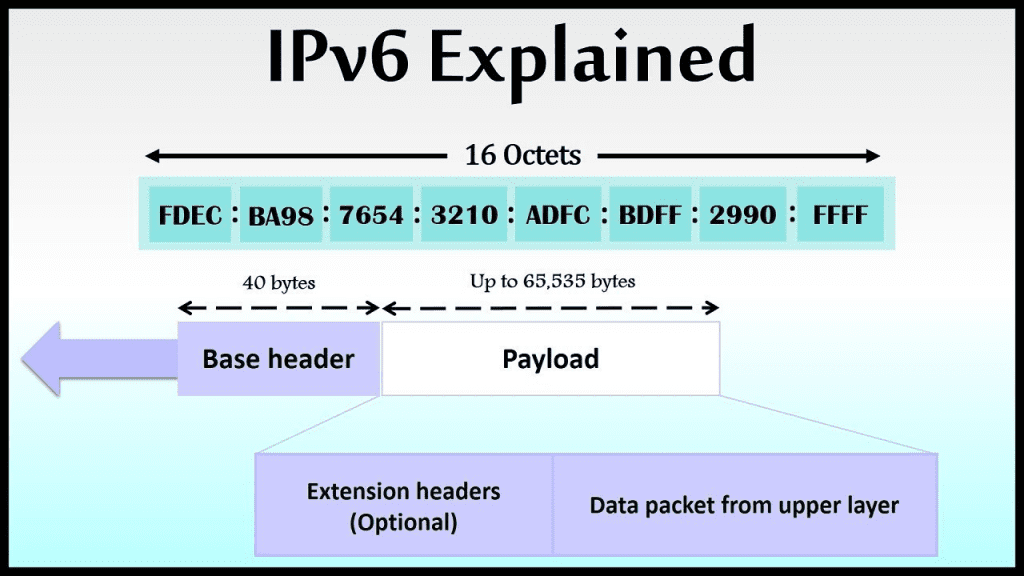
IPv6 uses 128-bit addresses instead of the 32-bit addresses used by IPv4. This allows for approximately 3.4 × 10³⁸ addresses—an almost unlimited number, sufficient to meet global connectivity needs for many decades to come.
Representation of IPv6 addresses
An IPv6 address is written as eight groups of hexadecimal numbers, with each group consisting of four characters and separated by colons (:).
Example:
2001:0db8:85a3:0000:0000:8a2e:0370:7334
IPv6 Address Shortening
IPv6 allows addresses to be shortened to improve readability and reduce the number of characters:
- Leading zeros in each group can be omitted.
- A consecutive sequence of zero groups can be replaced with
::(used only once in an address).
Example:
2001:db8:85a3::8a2e:370:7334
Comparison between IPv4 and IPv6
| Feature | IPv4 | IPv6 |
|---|---|---|
| Address length | 32-bit | 128-bit |
| Number of addresses | ~4.3 billion | ~3.4 × 10^38 |
| Security | Optional IPSec | Built-in IPSec |
| Representation | Dotted decimal | Hexadecimal |

3. Types of IPv6 Addresses
IPv6 classifies addresses into several different types to serve network connectivity and management purposes effectively. Each address type has its own function and scope of use:
Unicast: Represents a single device on the network. When data is sent to a unicast address, the packet is delivered directly to that specific device. This is the most common address type in network communication.
Multicast: Represents a group of devices. When data is sent to a multicast address, all devices in the group receive the data. This helps save bandwidth when sending the same data to multiple devices.
Anycast: Represents a set of devices, but packets are delivered to the nearest device based on routing. Anycast is commonly used in content delivery networks (CDNs) and load balancing systems.
Link-local: An address used only within a specific physical network segment. It allows devices on the same local network to communicate with each other without routing. Link-local addresses are mandatory for all IPv6 interfaces.
Global Unicast: A globally routable public address, similar to a public IP in IPv4. It allows devices to connect to the Internet and receive data from anywhere in the world.
Unique Local: An address used for internal networks, similar to private IP addresses in IPv4. Unique Local addresses are typically used in private network systems that do not directly connect to the Internet, while still ensuring uniqueness.
Example of an IPv6 address:
fe80::1ff:fe23:4567:890a   # Link-local
2001:0db8:85a3::8a2e:0370:7334  # Global Unicast
4. Advantages of IPv6 over IPv4
IPv6 offers many significant advantages over IPv4, helping to address long-standing limitations and meet the growing demands of the Internet:
- Unlimited address space: With 128-bit addresses, IPv6 provides an almost unlimited address space – approximately 3.4 × 10³⁸ addresses. This completely resolves the address exhaustion problem of IPv4 and supports the connection of billions of devices worldwide.
- Integrated security: IPv6 has IPSec built in, enabling data encryption and authentication at the protocol layer, thereby enhancing the security of network communications.
- Optimized routing: The IPv6 address structure is designed to simplify routing tables, reduce complexity, and improve data transmission performance across networks.
- IoT support: The vast address space of IPv6 allows Internet of Things (IoT) devices to be easily assigned unique addresses, supporting the development of large-scale smart device networks.
- Efficient network management: IPv6 supports stateless address autoconfiguration, reducing network management effort and simplifying the setup process.
5. Challenges in Deploying IPv6
Although IPv6 offers many benefits, its deployment still faces several notable challenges:
- Transition costs: Adopting IPv6 requires upgrades to hardware, software, and network devices, which can be costly for businesses and organizations.
- Compatibility: Some legacy devices or systems support only IPv4, leading to difficulties in integration and in ensuring seamless operation between IPv4 and IPv6.
- Workforce training: Deploying IPv6 requires new knowledge of IPv6 address structure, routing, and network management, making specialized training for technical staff necessary.
- New security issues: IPv6 introduces security models that differ from IPv4 and also opens up new potential vulnerabilities that must be studied and addressed to ensure network security.
6. IPv6 Deployment in Practice
In real-world network environments, IPv6 deployment typically follows one of three common approaches:
- Dual-stack: Devices are configured to run both IPv4 and IPv6 simultaneously. This approach ensures compatibility and allows networks to operate on both protocols during the transition period.
- Tunneling: IPv6 packets are encapsulated within IPv4 packets for transmission over IPv4 networks. This is a useful solution when the existing infrastructure does not yet fully support IPv6.
- Translation: Address and data translation between IPv4 and IPv6 enables devices or applications that support only one of the two protocols to communicate with each other.

Example in an enterprise environment:
A company deploys its internal network using a dual-stack model to ensure compatibility with IPv4 while also leveraging the benefits of IPv6. Critical servers are configured with IPv6 to enhance security and improve connection performance.
IPv6 also plays a crucial role in the development of the Internet of Things (IoT), enabling address allocation for billions of devices without limitations on address space.
7. Conclusion
This article has provided a comprehensive exploration of IPv6 – the next-generation Internet protocol designed to replace IPv4. It has introduced the concept of IPv6, its history of development, the reasons for its emergence, and its 128-bit address structure with the ability to offer an almost unlimited address space.
We have also examined the various types of IPv6 addresses, such as Unicast, Multicast, Anycast, Link-local, Global Unicast, and Unique Local, each serving specific purposes within network systems. IPv6 brings many notable advantages, including expanded address space, integrated IPSec security, optimized routing, IoT support, and more efficient network management.
At the same time, deploying IPv6 presents challenges such as transition costs, compatibility issues, workforce training requirements, and new security considerations. The article has discussed common IPv6 deployment methods in practice, including Dual-stack, Tunneling, and Translation, while emphasizing the important role of IPv6 in the Internet of Things era.
Overall, IPv6 is not merely a technical solution for expanding the Internet address space, but also a foundation for the sustainable development of the global network. Understanding and adopting IPv6 will help us prepare for the future, optimize network infrastructure, and enhance connectivity efficiency in the modern Internet environment.
8. References
[1] S. Deering and R. Hinden, Internet Protocol, Version 6 (IPv6) Specification, RFC 2460, Dec. 1998. [Online]. Available: https://www.rfc-editor.org/info/rfc2460
[2] P. Srisuresh and K. Egevang, IPv6 Transition Mechanisms, RFC 2893, Aug. 2001. [Online]. Available: https://www.rfc-editor.org/info/rfc2893
[3] Cisco Systems, What is IPv6?, 2025. [Online]. Available: https://www.cisco.com/c/en/us/products/security/what-is-ipv6.html