In software development, writing code that “works” has never been the ultimate goal. As a system grows, the number of features increases, and more developers become involved, the biggest challenge no longer lies in syntax or programming languages, but in how the source code is organized and designed. A poorly designed system will quickly become difficult to maintain, hard to extend, and fraught with risks over the course of long-term development.
Design Patterns emerged as a collection of proven solutions to address common design problems in object-oriented programming. However, in practice, many developers struggle to approach this topic because most reference materials and books tend to be highly academic, filled with abstract concepts and offering few examples tied to real-world situations.
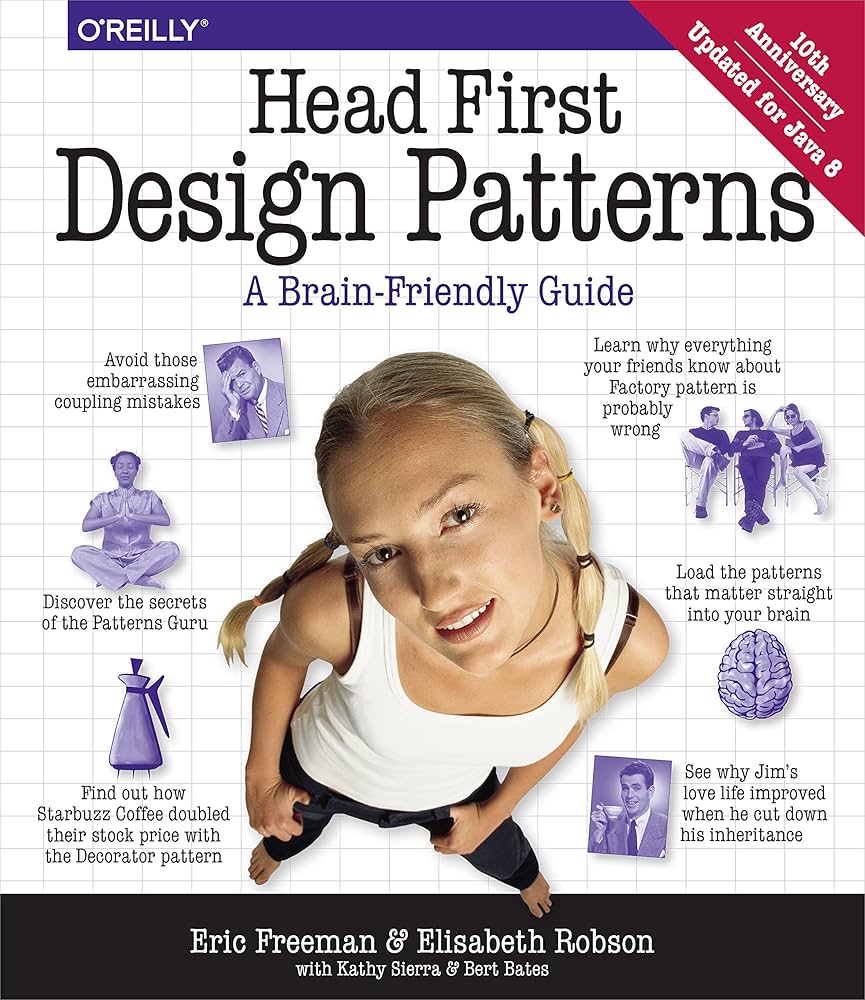
Head First Design Patterns by Eric Freeman and Elisabeth Robson is one of the few books that approaches Design Patterns in a completely different way. Instead of focusing on dry definitions, the book helps readers grasp the essence of each design pattern through visual, easy-to-understand, and highly practical examples. As a result, Design Patterns are no longer hard-to-approach concepts, but practical tools that help developers improve the quality of their software design.
With more than a decade since its first publication and multiple content updates, Head First Design Patterns has become a classic reference for the global programming community, especially for those who want to build a solid foundation in design thinking and software architecture.
1. Basic Information about the Book
- Book title: Head First Design Patterns
- Authors: Eric Freeman & Elisabeth Robson
- Publisher: O’Reilly Media
- Notable edition: 10th Anniversary Edition (updated for Java 8)
- Primary language: English
- Topics: Design Patterns, Object-Oriented Design, Software Architecture
Head First Design Patterns is one of the most prominent books on software design in O’Reilly’s Head First series. The book is authored by Eric Freeman and Elisabeth Robson—two writers with many years of experience in software development and technical education. Their works are consistently highly regarded for their ability to convey complex concepts in a clear, approachable, and learner-friendly manner.
The distinctive hallmark of the Head First series in general, and Head First Design Patterns in particular, lies in its visual, lively, and brain-friendly presentation style. Rather than focusing solely on dry theory, the book combines illustrations, real-world examples, dialogues, and diagrams to help readers gain a deep understanding of the core concepts while retaining the knowledge more effectively over time.
Although the illustrative examples in the book are primarily written in Java, and the 10th Anniversary Edition has been updated for Java 8, the core content of the book is not tied to any specific programming language. The design principles and design patterns presented are universal in nature and can be fully applied to other object-oriented languages such as C#, Python, JavaScript, PHP, as well as many modern software development platforms.
2. Content Overview
Head First Design Patterns is not merely a book that lists design patterns, but a journey that helps readers clearly understand how to think and make decisions throughout the process of object-oriented software design. The book’s content is built around problems that frequently arise in real-world software development, guiding readers to approach design patterns as time-tested solutions.
The book opens by raising questions that are very familiar to programmers: why a system that initially works well gradually becomes difficult to maintain, why adding a new feature often triggers a cascade of unintended changes, and why code that seems simple at first quickly grows complex as a project scales. Through concrete examples, the authors point out that the root cause lies not in the programming language itself, but in the way the code is designed and organized.
From there, each design pattern is introduced using a consistent and easy-to-follow structure. Each chapter typically begins with a real-world scenario, describing an initial approach that many developers commonly take. While this approach may solve the immediate problem, it often reveals significant limitations in terms of flexibility, extensibility, and the level of coupling between components in the system. After clearly analyzing these issues, the book then presents the appropriate design pattern as a more optimal solution.
One notable strength of Head First Design Patterns is that it does not present patterns in a mechanical way. Instead of introducing definitions and UML diagrams right from the start, the authors guide readers step by step toward the essence of each pattern, helping them understand why the pattern exists and what problem it is intended to solve. Concepts such as the Strategy Pattern, Observer Pattern, Decorator Pattern, Factory Pattern, and Singleton Pattern are all placed in familiar contexts, making it easy for readers to relate them to their everyday programming work.
Alongside the introduction of specific design patterns, the book places strong emphasis on the core design principles of object-oriented programming. Principles such as separating what varies, programming to interfaces rather than concrete implementations, and favoring composition over inheritance are reinforced throughout the book. This approach helps readers not only learn how to apply individual patterns, but also develop an overall mindset for designing robust software systems.
In addition, Head First Design Patterns devotes considerable attention to explaining when design patterns should not be used. The authors repeatedly emphasize that patterns are not the goal, but merely tools. Overusing patterns or applying them in inappropriate contexts can make a system more complex than necessary. This balanced approach helps readers avoid common mistakes when first learning about design patterns.
Throughout the book, the examples and hands-on exercises are designed to encourage readers to actively think and analyze problems, rather than passively absorb information. As a result, Head First Design Patterns not only provides foundational knowledge of design patterns, but also helps readers develop the ability to evaluate and choose appropriate design solutions in a variety of situations.
3. Why Should You Read This Book?
Head First Design Patterns delivers its greatest value by helping developers transform their mindset about software design, rather than merely learning to apply design patterns in a mechanical way. The book focuses on clarifying the essence of each design problem, enabling readers to understand why design patterns exist and when they are truly necessary. This approach empowers developers to make more sound design decisions in real-world projects.
Another notable aspect is the book’s ability to convey complex knowledge in an accessible way. Compared to many highly academic design pattern resources, Head First Design Patterns uses clear language, visual examples, and familiar scenarios, allowing readers to absorb the material naturally while still maintaining strong technical depth.
Beyond its accessibility, the book also has strong practical value in software development work. The issues analyzed in the book accurately reflect the challenges that developers commonly face when building and scaling systems, especially in medium- to large-scale projects. As a result, the knowledge gained goes beyond theory and can be applied directly in practice.
Beyond its accessibility, the book also offers a high level of practical applicability in real-world software development. The problems analyzed in the book accurately reflect the challenges developers commonly face when building and scaling systems, especially in medium- to large-scale projects. As a result, the knowledge gained goes beyond theory and can be applied directly in practice.
4. Who Is This Book For?
Head First Design Patterns is best suited for developers who already have a basic understanding of object-oriented programming and wish to improve the quality of their software design. For computer science students or those early in their careers, the book serves as an important bridge between learning programming syntax and developing higher-level system design thinking.
The book is also particularly useful for junior and mid-level developers working on real-world projects. As systems grow in scale, issues related to maintenance, extensibility, and dependency management between components become more apparent. Head First Design Patterns helps this audience understand and apply common design patterns to improve code structure, thereby enhancing productivity and overall product quality.
In addition, developers with long-term career goals—especially those preparing for technical interviews or aiming to become mid-level and senior software engineers—will also find significant value in this book. Mastering design patterns helps them not only answer technical questions effectively, but also demonstrate strong design thinking and a systematic approach to problem analysis.
However, Head First Design Patterns is not a suitable choice for those who lack a basic programming foundation or are only interested in learning the syntax of a specific language. The book focuses on design thinking and core principles, so readers need a certain level of understanding of object-oriented programming in order to absorb the content effectively.
5. Download and Experience
You can easily download or read this book online on various platforms such as SlideShare, Scribd, Issuu, or Studylid. Each platform supports online reading, saving for later, and downloading when needed, making it convenient for both computers and mobile devices. Choose the platform that best suits your usage habits to fully enjoy the book’s content.
- Studylid: https://studylib.net/doc/27956323
- Slideshare (Part 1): https://www.slideshare.net/slideshow/practical-statistics-for-data-scientists-50-essential-concepts-using-r-and-python-part-1/284083302
- Slideshare (Part 2): https://www.slideshare.net/slideshow/practical-statistics-for-data-scientists-50-essential-concepts-using-r-and-python-part-2/284083341
6. References
[1] E. Freeman, E. Robson, B. Bates and K. Sierra, Head First Design Patterns, 10th Anniversary ed. Sebastopol, CA, USA: O’Reilly Media, 2014.
[2] E. Gamma, R. Helm, R. Johnson and J. Vlissides, Design Patterns: Elements of Reusable Object-Oriented Software. Boston, MA, USA: Addison-Wesley, 1994.
[3] R. C. Martin, Clean Code: A Handbook of Agile Software Craftsmanship. Upper Saddle River, NJ, USA: Prentice Hall, 2008.
[4] R. C. Martin, Clean Architecture: A Craftsman’s Guide to Software Structure and Design. Boston, MA, USA: Pearson, 2017.
[5] M. Fowler, Refactoring: Improving the Design of Existing Code, 2nd ed. Boston, MA, USA: Addison-Wesley, 2018.
[6] S. McConnell, Code Complete: A Practical Handbook of Software Construction, 2nd ed. Redmond, WA, USA: Microsoft Press, 2004.
[7] OpenDev, Foundations of Information Systems. Available: https://kienthucmo.com/en/foundations-of-information-systems/
[8] OpenDev, Introduction to Computer Science. Available: https://kienthucmo.com/en/introduction-to-computer-science/
[9] OpenDev, Principles of Data Science. Available: https://kienthucmo.com/en/principles-of-data-science/