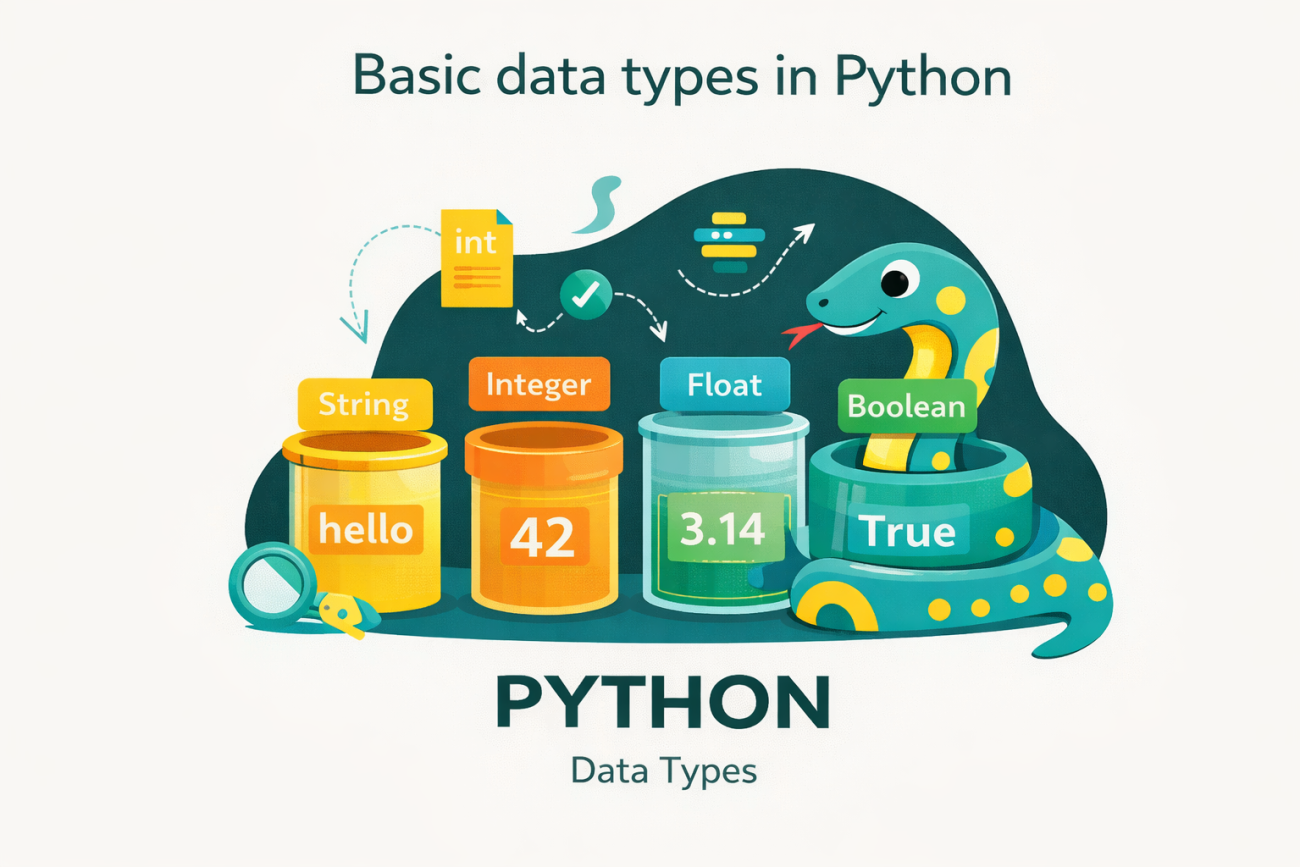
In the world of programming, everything begins with data. When writing programs, we must store, process, and transmit data in many different forms: numbers, text, collections of lists, or even binary data. To handle these effectively, programming languages provide us with data types.
Python – one of the most popular programming languages today – is well known for its simple and flexible syntax. However, this very flexibility often leads beginners to overlook an extremely important aspect: mastering data types. Understanding the data you are working with helps you write safer programs, makes them easier to maintain, and allows you to fully leverage the power of Python.
This article will accompany you in exploring data types in Python in detail – from basic to advanced – along with illustrative examples and practical applications.
1. Overview of Data Types in Python
In Python, everything is an object. An integer (int), a string (str), and even a function you write are all objects, each with its own data type and equipped with attributes and methods for manipulation.
Python is characterized by dynamic typing – meaning you do not need to declare a data type when creating a variable. Python will automatically infer the type from the assigned value:
x = 5         # x là int
y = 3.14      # y là float
name = "KienThucMo" # name là strThis makes Python very beginner-friendly, but it also requires programmers to clearly understand data types in order to avoid errors during processing.
2. Basic Data Types
2.1 Integers (int)
- Represents values without a fractional (decimal) part.
- Python does not limit the size of an
int, as long as there is sufficient memory available.
Example:
a = 10
b = -250
big = 123456789123456789Applications: used for counting, serving as array indices, or representing large numbers in computational science.
2.2 Floating-point Numbers (float)
- Used to store numbers with a fractional (decimal) part.
- They follow the IEEE 754 standard, so rounding errors may occur.
Example:
x = 0.1 + 0.2
print(x) # 0.30000000000000004Applications: used in mathematical calculations, scientific simulations, and statistical data.
2.3 Strings (str)
- Represents text and supports Unicode.
- Can be defined using single quotes (‘), double quotes (“), or triple quotes (”’ / “””).
- Supports indexing, slicing, and f-string formatting:
name = "Python"
print(name[0])      # P
print(name[-1])     # n
print(f"Hello {name}!") # Hello Python!Applications: used for text processing, language data analysis, and information display.
2.4 Boolean (bool)
- Has two values: True and False.
- Commonly appears in
ifconditions, loops, or as the result of comparisons:
is_valid = 5 > 3
print(is_valid) # TrueApplications: used to control program flow and validate data.
3. Collection Data Types
3.1 List
- Ordered, mutable, and allows storing multiple data types.
- Provides many useful methods such as
append,remove, andsort.
fruits = ["apple", "banana", "cherry"]
fruits.append("orange")
print(fruits) # ['apple', 'banana', 'cherry', 'orange']Applications: used to store user lists, datasets, and system logs.
3.2 Tuple
- Similar to a list but immutable (cannot be changed after creation).
- Faster to access than lists and used for fixed data.
point = (3, 4)
print(point[0]) # 3Applications: used for coordinates and immutable configurations.
3.3 Set
- An unordered collection with no duplicate elements.
- Supports set operations such as union, intersection, and difference
a = {1, 2, 3}
b = {3, 4, 5}
print(a | b) # {1, 2, 3, 4, 5}Applications: used to remove duplicate data and handle set relationships.
3.4 Dictionary (dict)
- A mapping structure of key–value pairs.
- Keys must be immutable, such as
str,int, ortuple.
person = {"name": "Alice", "age": 25}
print(person["name"]) # AliceApplications: used to represent JSON, store structured information, and manage configurations.
4. Special Data Types
4.1 NoneType
- Has only one unique value:
None. - Represents “nothing” or the absence of a value.
def func():
    pass

print(func()) # None4.2 Bytes and Bytearray
- Used for binary data.
bytesare immutable, whilebytearrayis mutable.
data = b"hello"
arr = bytearray([65, 66, 67])4.3 Frozenset
- The immutable version of a set.
- Used as a key in a dictionary.
fs = frozenset([1, 2, 3])4.4 Memoryview
- Allows access to binary data without copying.
- Useful for handling large files or system-level programming.
5. Type Conversion
Python supports two methods:
Implicit: Python automatically performs conversions when necessary.
x = 10       # int
y = 2.5      # float
z = x + y    # float
print(z) # 12.5print(int("123")) # 123
print(float("3.14")) # 3.14
print(list("abc")) # ['a', 'b', 'c']⚠️ Lưu ý: ép kiểu sai sẽ gây lỗi.
int("Kienthucmo") # ValueError6. Conclusion
Data types in Python are not just basic theory but also the foundation that determines whether you can develop complex applications. Understanding and using data types correctly will help you:
- Write accurate programs with fewer errors.
- Optimize performance, especially when working with large datasets.
- Easily expand into advanced fields such as data analysis, machine learning, and web development.
If you are just starting with Python, practice with each data type through examples and try combining them in small problems. Once you become proficient, you will find that learning advanced concepts becomes much easier.
7. References
- Python Software Foundation. (2024). The Python Standard Library – Built-in Types. Python.org. Truy cập từ: https://docs.python.org/3/library/stdtypes.html
- Real Python. (2023). Understanding Data Types in Python. RealPython.com. Truy cập từ: https://realpython.com/python-data-types/
- W3Schools. (2024). Python Data Types. W3Schools Online Web Tutorials. Truy cập từ: https://www.w3schools.com/python/python_datatypes.asp
- GeeksforGeeks. (2023). Python Data Types. GeeksforGeeks.org. Truy cập từ: https://www.geeksforgeeks.org/python-data-types/
- Python for Professionals: Learning Python as a Second Language: https://www.kobo.com/us/en/ebook/python-for-professionals-3
- Python: Deeper Insights into Machine Learning: https://www.kobo.com/us/en/ebook/python-deeper-insights-into-machine-learning
- DataFusion Python Bindings in Practice: The Complete Guide for Developers and Engineers: https://www.kobo.com/us/en/ebook/datafusion-python-bindings-in-practice