The rapid growth of distributed systems, cloud computing, the Internet of Things (IoT), and digital services has made information security one of the core challenges of modern software engineering. No longer limited to data protection or intrusion prevention, security today is closely intertwined with system reliability, long-term operational resilience, and overall system safety – especially in large -scale, highly distributed systems composed of many components and influenced by both human and organizational factors.
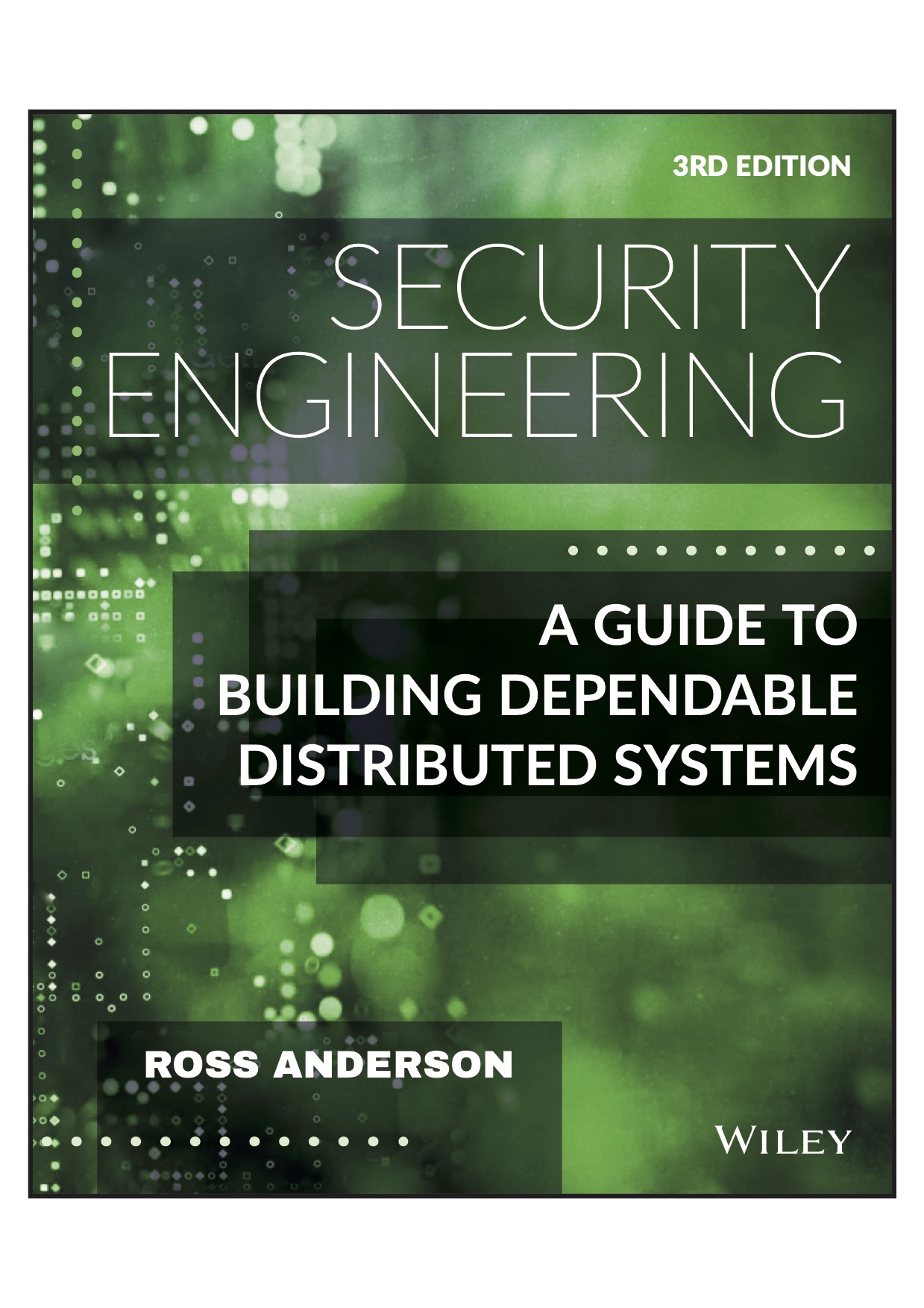
In this context, Security Engineering: A Guide to Building Dependable Distributed Systems by Ross Anderson is widely regarded as one of the most foundational and comprehensive works on system security engineering. Rather than being merely a book about cryptography or network security, Security Engineering approaches security as a true engineering discipline – one in which design decisions are simultaneously shaped by technology, economics, human behavior, and policy considerations.
With its exceptionally broad scope and rare analytical depth, the book has become a canonical reference for security engineers, system architects, and researchers for decades.
1. Basic Information about the Book
- Security Engineering: A Guide to Building Dependable Distributed Systems
- Author: Ross Anderson
- Publisher: Wiley
- Edition: Third Edition
- Year of Publication: 2020–2021
- Length: Approximately 1,200 pages
- Fields: System security, software engineering, distributed systems, information security
Ross Anderson is a professor at the University of Cambridge and one of the pioneering scholars who laid the foundations for the fields of security engineering and the economics of security. His research has had a profound influence on how the engineering community understands security—not as an add-on layer of protection, but as a fundamental property of systems.
The third edition of the book has been substantially updated, incorporating modern topics such as cloud computing, the Internet of Things (IoT), and industrial systems, along with new analyses of the economics and policy dimensions of security.
2. Content Overview
2.1. Security as an Engineering Discipline
From the very first chapters, Ross Anderson clearly articulates the concept of security engineering. According to him, security is not merely about deploying isolated technical mechanisms such as encryption, authentication, or firewalls. Instead, security is the art and science of designing systems that can continue to operate correctly even in the presence of faults, attacks, or misuse.
This perspective helps readers shift their mindset: rather than asking “how can we prevent every possible attack?”, the more appropriate question is “how will the system behave when part of it is compromised?”.
2.2. Security Goals and Models
The book provides a detailed analysis of the core security objectives, most notably the Confidentiality–Integrity–Availability (CIA) triad, while also emphasizing that, in practice, these goals often conflict with one another.
Ross Anderson then goes on to present several classical security models, such as:
- Bell–LaPadula model (information confidentiality)
- Biba model (data integrity)
- Clark–Wilson model (integrity in commercial environments)
What is distinctive is that the author does not merely describe these models, but also analyzes their contexts of use, strengths, limitations, and the implicit assumptions that cause many of them to fail when applied mechanically to real-world systems.
2.3. Technical Mechanisms and System Resources
A substantial portion of the book focuses on foundational technical mechanisms, including:
- Cryptography: not only explaining algorithms, but emphasizing the correct use of cryptographic techniques in protocol design, rather than treating cryptography as an isolated mathematical component.
- Access Control and Authorization: spanning from operating systems to distributed systems.
- Authentication and Identification: common mistakes in designing login mechanisms and identity management.
- Protocols and Distributed Systems: where network and node unreliability become central challenges.
The author repeatedly emphasizes that most security incidents do not stem from weak algorithms, but from poor system design or incorrect assumptions about the operational environment.
2.4. Human Factors and the Economics of Security
One of the greatest contributions of Security Engineering is placing economics and human behavior at the center of security analysis.
Ross Anderson points out that:
- Users often compromise security because systems are too complex or do not align with natural human behavior.
- Organizations may accept security risks if the cost of mitigation is lower than the cost of preventive investment.
- Software vendors are not always directly accountable for the security consequences.
These analyses help readers understand that security failures are often the result of misaligned incentives, rather than merely a lack of technology.
2.5. Case Studies and Application Domains
The book contains a series of real-world case studies in:
- Banking and Payment Systems
- Healthcare and Electronic Medical Records
- Industrial Control Systems
- National and Military Infrastructure
- IoT and Cloud Platforms
These examples demonstrate that security is always a trade-off among protection, cost, performance, and usability, and that no perfect solution exists.
3. Why Should You Read This Book?
The greatest value of Security Engineering: A Guide to Building Dependable Distributed Systems lies in its ability to help readers understand and approach security as an engineering problem at the architectural level, rather than viewing it as a set of defensive measures added after the system is built. Ross Anderson emphasizes that security must be designed from the outset, tightly integrated with system architecture, trust models, and the allocation of privileges.
The book is particularly compelling in its ability to analyze the root causes of real-world security failures. Rather than focusing solely on vulnerabilities or attack techniques, the author points out that most incidents stem from poor design, unrealistic assumptions about the operational environment, and incomplete threat assessments. This approach helps readers move beyond a “patch-and-fix” mindset while developing the capability to assess risks systematically.
Beyond technical aspects, Security Engineering also offers a rare perspective on the roles of humans, organizations, and economic incentives in system security. The author demonstrates that many insecure systems are not the result of lacking technology, but of design decisions driven by cost, business benefits, and user behavior. It is precisely this integration of engineering principles with real-world context that gives the book enduring value, transcending the limitations of specific technologies or fleeting trends.
4. Who Is This Book For?
Security Engineering: A Guide to Building Dependable Distributed Systems is well-suited for readers with a certain technical background who wish to understand security at the system level, rather than focusing solely on specific defensive techniques.
First and foremost, the book is particularly valuable for software engineers and system architects involved in designing or operating distributed systems, large service platforms, and applications with high reliability requirements. For this audience, it clarifies the relationships between architecture, access control, data flows, and overall system security—factors that are often difficult to discern when focusing solely on code.
Additionally, cybersecurity professionals, DevSecOps engineers, and security architects will find in the book a comprehensive framework for risk assessment. Its content helps them understand why many defensive mechanisms fail in practice, enabling more informed decisions when integrating security into the system development and operational lifecycle.
The book is also highly suitable for graduate students, academics, and advanced learners in the fields of information security, distributed systems, and software engineering. Its foundational knowledge, combined with interdisciplinary analyses, helps broaden research thinking, particularly at the intersection of engineering, economics, and security policy.
Finally, engineering managers, CTOs, and technology decision-makers can use the book as a guiding resource. While it does not focus on implementation details, it helps this audience understand the trade-offs between security, cost, and operational feasibility, enabling strategic decisions based on risk rather than intuition.
5. Conclusion
Security Engineering: A Guide to Building Dependable Distributed Systems is not merely a book on information security, but a foundational work that shapes the approach to security as a complete systems engineering discipline. By tightly integrating engineering principles, system architecture, human factors, and economic incentives, Ross Anderson demonstrates that security cannot be achieved through isolated or reactive measures, but must be deliberately designed from the outset.
The core value of the book lies in helping readers identify and deeply understand the nature of security issues, rather than focusing solely on surface symptoms such as vulnerabilities or attack techniques. This approach is especially important in the context of increasingly complex distributed systems, where security failures often originate from architecture, design assumptions, and operational organization rather than from individual technologies.
With its broad scope, deep analysis, and enduring value that transcends short-term technological trends, Security Engineering deserves to be regarded as a classic reference for anyone serious about building secure, resilient, and reliable distributed systems. This is not a book to skim, but one to read carefully, reflect upon, and apply thoughtfully over the long term in engineering practice.
6. Download and Explore
You can easily download or read this book online on various platforms such as SlideShare, Scribd, Issuu, or Studylid. Each platform supports direct reading, saving for later, and downloading when needed, making it convenient for both computers and mobile devices. Choose the platform that best fits your usage habits to fully experience the content of the book.
- Studylid: https://studylib.net/doc/27956323
- Slideshare (Part 1): https://www.slideshare.net/slideshow/practical-statistics-for-data-scientists-50-essential-concepts-using-r-and-python-part-1/284083302
- Slideshare (Part 2): https://www.slideshare.net/slideshow/practical-statistics-for-data-scientists-50-essential-concepts-using-r-and-python-part-2/284083341
7. Reference
[1] R. Anderson, Security Engineering: A Guide to Building Dependable Distributed Systems, 3rd ed. Hoboken, NJ, USA: Wiley, 2021.
[2] R. Anderson, “Why Information Security Is Hard—An Economic Perspective,” in Proc. 17th Annual Computer Security Applications Conference (ACSAC), New Orleans, LA, USA, 2001, pp. 358–365, doi: 10.1109/ACSAC.2001.991552.
[3] M. Bishop, Computer Security: Art and Science, 2nd ed. Boston, MA, USA: Addison-Wesley, 2019.
[4] B. Schneier, Secrets and Lies: Digital Security in a Networked World. New York, NY, USA: Wiley, 2000.
[5] R. Anderson, “Security Engineering Lecture Notes,” Computer Laboratory, University of Cambridge, Cambridge, U.K., [Online]. Available: https://www.cl.cam.ac.uk/~rja14/book.html
[6] IEEE Security & Privacy Society, “Book Review: Security Engineering (3rd Edition),” IEEE Security & Privacy, 2021.