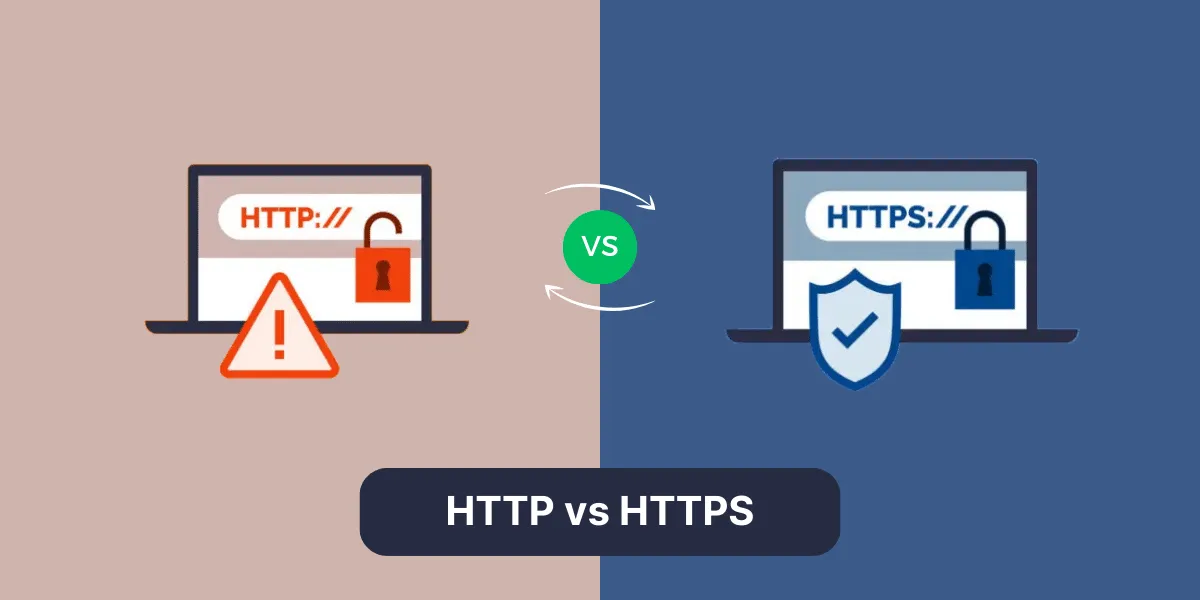
In the era of rapid Internet development, the transmission of information between devices has become extremely important. When accessing a website, you often encounter two common protocols: HTTP and HTTPS. But how exactly do they differ? How does HTTP work, what makes HTTPS special, and why has security become such an important factor for websites today?
In this article, I will explore these two protocols in depth with you. We will examine their operating mechanisms, advantages and disadvantages, how to distinguish between them, as well as key considerations when deploying a secure website. Let’s get started.

1. What Is HTTP?
HTTP (HyperText Transfer Protocol) is a protocol used to exchange information between a client (typically a web browser) and a server on the Internet. It enables data to be sent and received in the form of requests and responses and serves as the fundamental foundation of the World Wide Web. Whenever you access a website, all data such as text, images, and videos are transmitted via HTTP (or HTTPS).

Basic Operating Mechanism:
- Client sends a request: When you enter a website address or click a link, the browser creates an HTTP request. This request includes information such as the URL being accessed, the HTTP method (GET, POST, etc.), headers (details about the browser, cookies, and more), and sometimes a body containing data to be sent.
- Server processes the request: The server receives the request, analyzes the information, retrieves the necessary data (such as an HTML page, images, or JSON data), and generates an HTTP response. The response includes a status code indicating the result, headers containing metadata about the returned data, and a body with the actual content.
- Client receives the response: The browser receives the response, reads the headers and body, and then displays the website content to the user. This process occurs very quickly – often within milliseconds – allowing the website to load almost instantly.
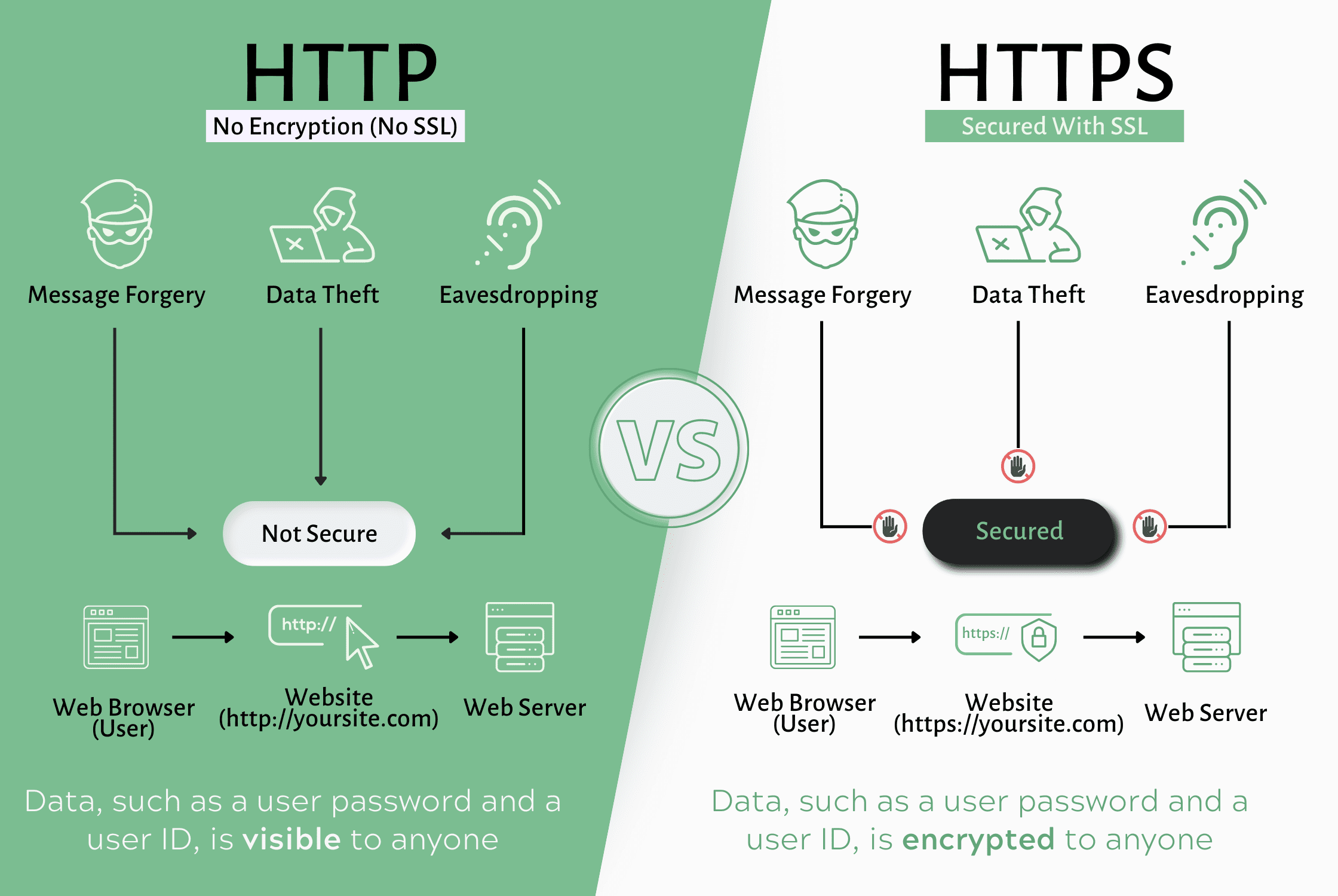
Thanks to this request – response mechanism, HTTP enables efficient communication between users and servers; however, it is important to note that the transmitted information is not encrypted.
2. What Is HTTPS?
HTTPS (HyperText Transfer Protocol Secure) is the secure version of HTTP. It uses SSL/TLS to encrypt data before it is transmitted over the Internet, helping to protect sensitive information and ensuring that data cannot be read or altered by malicious actors. HTTPS also authenticates the server’s identity, giving users confidence that they are connecting to a legitimate website.

Basic Operating Mechanism:
- Client requests a secure connection: When you access a website using HTTPS, the browser sends a request to establish a secure connection with the server.
- Server sends an SSL/TLS certificate: The server provides a certificate to verify its identity, proving that it is a legitimate website.
- Session key exchange: The client and server negotiate a temporary encryption key (session key) to be used during the communication session.
- Encrypted data transmission: All requests and responses within the session are encrypted, ensuring data confidentiality and integrity.
Key advantages of HTTPS:
- Data security: All transmitted information is encrypted.
- Server authentication: Reduces the risk of website impersonation.
- SEO and credibility: Google prioritizes websites that use HTTPS.
- Increased trust: Users feel more secure when seeing the padlock icon in the browser.
3. Comparison Between HTTP and HTTPS
| Criteria | HTTP | HTTPS |
|---|---|---|
| Security | Not encrypted | Encrypted using SSL/TLS |
| Port | 80 | 443 |
| Performance | Faster, no overhead | Slightly slower due to encryption |
| Server authentication | None | Server authentication enabled |
| SEO & credibility | Lower | Preferred by search engines, higher trust |
| Sensitive information | Easily intercepted | Secure, protects users |
Compared to HTTP, HTTPS provides a significantly higher level of security by encrypting data and authenticating the server, which helps keep user information safe. This also enhances a website’s credibility and trustworthiness, while being favored by search engines. In contrast, HTTP may still be suitable for testing environments, internal websites, or cases where security is not a critical concern. However, for public websites – especially those handling sensitive information – HTTPS is always the preferred choice.
4. When to Use HTTP and HTTPS
HTTP: HTTP is suitable for internal or testing websites where data is not sensitive. It is also commonly used for learning projects, feature demos, or development environments because it is quick and simple to deploy.
HTTPS: HTTPS should be used for commercial websites, banking platforms, or online shopping sites where user information must be protected. In addition, websites that require login, store personal data, or share sensitive documents should also implement HTTPS to ensure security.
Notes when migrating from HTTP to HTTPS:
- Purchase or install an SSL/TLS certificate.
- Configure a 301 redirect to forward all traffic from HTTP to HTTPS.
- Update internal links to avoid mixed content issues and ensure stable, secure operation.
5. Tips for Checking and Installing HTTPS
Check whether a website uses HTTPS: You can easily identify whether a website uses HTTPS by looking at the browser address bar: if there is a padlock icon or the URL starts with https://, the site is secured.
Install free SSL with Let’s Encrypt:
- Register the domain you want to secure.
- Install Let’s Encrypt on the server to issue an SSL certificate.
- Configure automatic certificate renewal to ensure HTTPS remains active.
- Verify the setup using a web browser or online tools such as SSL Labs to ensure the website is properly secured.
6. Conclusion
HTTP is a fundamental protocol that enables data exchange on the Internet, but information transmitted via HTTP is not encrypted and is vulnerable to attacks. HTTPS improves upon this by using SSL/TLS to encrypt data, authenticate the server, and protect data integrity. The differences between HTTP and HTTPS affect not only security but also a website’s credibility and SEO. Implementing HTTPS is essential for websites that handle sensitive data, and it also opens up further research directions into TLS/SSL and newer HTTP versions such as HTTP/2 to optimize performance and security.
7. References
[1] T. Berners-Lee, “Hypertext Transfer Protocol – HTTP/1.1,” RFC 2616, IETF, 1999.
[2] E. Rescorla, “HTTP Over TLS,” RFC 2818, IETF, 2000.
[3] M. Nottingham, HTTP/2: A New Exponent for the Web, O’Reilly Media, 2015.
[4] Mozilla Developer Network, “Introduction to HTTPS,” [Online]. Available: https://developer.mozilla.org/en-US/docs/Web/HTTP/Overview.
[5] Let’s Encrypt, “Free SSL/TLS Certificates,” [Online]. Available: https://letsencrypt.org/.
[6] Google, “HTTPS as a ranking signal,” [Online]. Available: https://developers.google.com/search/blog/2014/08/https-as-ranking-signal.
[7] OWASP, “Transport Layer Protection Cheat Sheet,” [Online]. Available: https://cheatsheetseries.owasp.org/cheatsheets/Transport_Layer_Protection_Cheat_Sheet.html