Posted in

Practical Statistics for Data Scientists: 50+ Essential Concepts Using R and Python

Practical Statistics for Data Scientists – 50+ Essential Concepts Using R and Python

Trong kỷ nguyên mà dữ liệu trở thành “ngôn ngữ chung” của thế giới, việc hiểu và biết cách khai thác dữ liệu không còn là lợi thế — mà là yêu cầu tối thiểu. Thế nhưng, giữa vô số công cụ, thư viện và mô hình máy học mới xuất hiện mỗi ngày, có một kỹ năng nền tảng vẫn giữ nguyên sức mạnh qua thời gian: thống kê. Không có thống kê, mọi mô hình chỉ là những phép thử mù mờ; không có thống kê, mọi con số chỉ là những dữ liệu rời rạc không mang ý nghĩa.

Vấn đề là: thống kê thường bị xem như một bộ môn khô khan, đầy công thức, khó tiếp cận. Nhiều người bắt đầu học Data Science đều vấp phải cảm giác “không biết mình thật sự cần hiểu những gì”, hoặc “không biết phải bắt đầu từ đâu trong mớ kiến thức rộng lớn này”.

Chính ở khoảng trống đó, Practical Statistics for Data Scientists xuất hiện như một cây cầu — kết nối người học với thống kê theo hướng thực tế, dễ hiểu và trực tiếp phục vụ công việc phân tích dữ liệu. Không nặng nề lý thuyết, không chìm trong các công thức dài dòng, cuốn sách này đi thẳng vào điều mà một Data Scientist cần: hiểu đúng, dùng đúng và ứng dụng hiệu quả hơn 50 khái niệm thống kê quan trọng nhất.

Nếu bạn đang muốn nắm chắc nền tảng thống kê, hiểu sâu những gì mình đang làm với dữ liệu, hoặc đơn giản chỉ muốn trở nên tự tin hơn khi lập mô hình, phân tích, trực quan hóa hay đánh giá chất lượng dự đoán — thì đây chính là cuốn sách bạn cần đặt trên bàn làm việc.
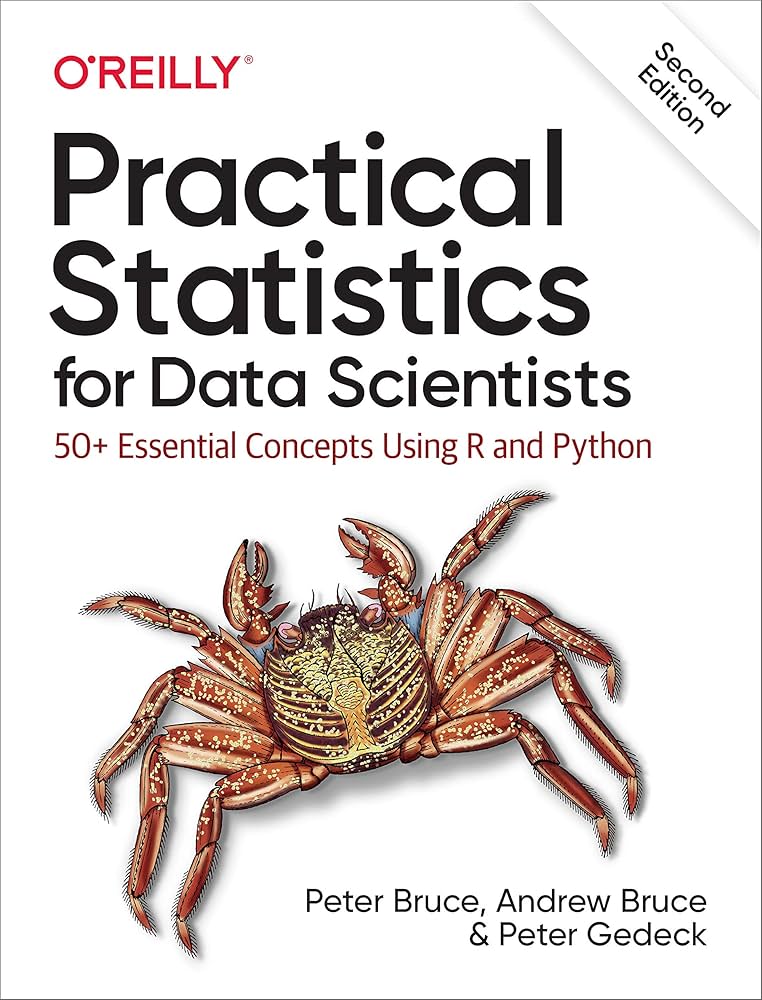
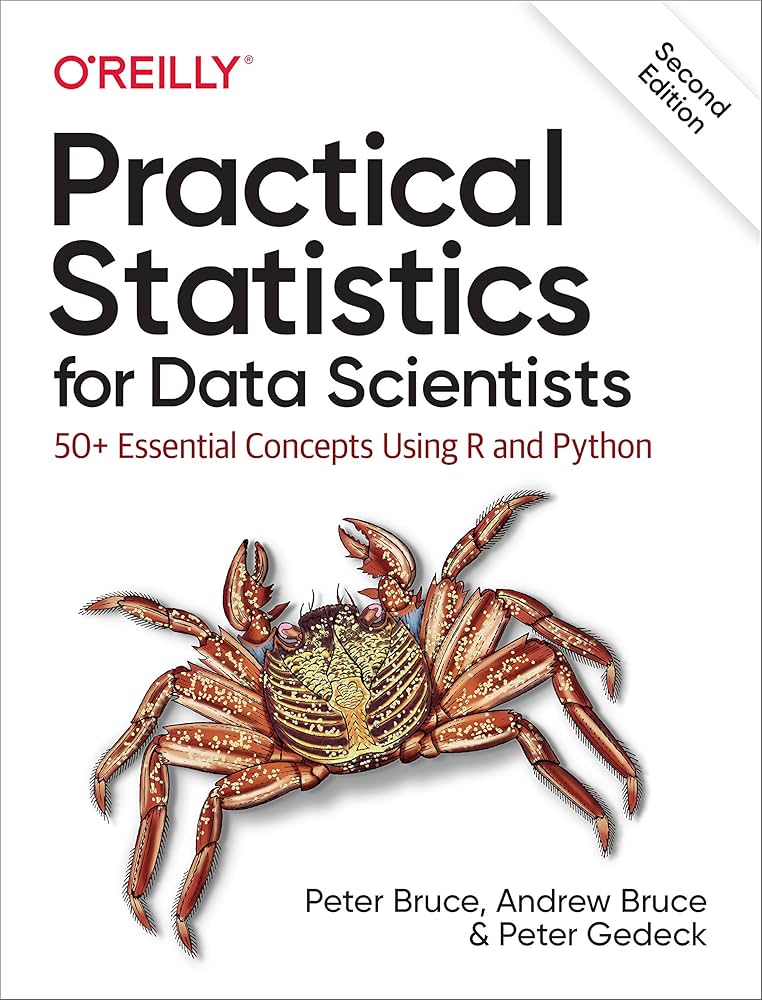
Practical Statistics for Data Scientists: 50+ Essential Concepts Using R and Python

1. Thông tin cơ bản về cuốn sách

Tên sách: Practical Statistics for Data Scientists: 50+ Essential Concepts Using R and Python
Tác giả: Peter Bruce, Andrew Bruce, và Peter Gedeck
Nhà xuất bản: O’Reilly Media
Nội dung chính: Cung cấp nền tảng thống kê hiện đại, thực tiễn và dễ áp dụng cho khoa học dữ liệu; giúp người đọc hiểu đúng – dùng đúng các khái niệm thống kê quan trọng trong phân tích và xây dựng mô hình.
Ngày phát hành: Phiên bản đầu tiên: 2017 – Phiên bản thứ hai (bản phổ biến nhất): 2020
Giấy phép: Bản thương mại do O’Reilly phát hành (bản PDF lưu hành thường là bản số hóa để tham khảo)
Số trang: Khoảng 350+ trang tùy phiên bản
Điểm nổi bật: Trình bày hơn 50 khái niệm thống kê cốt lõi dưới góc nhìn thực tế của Data Science; minh họa song song bằng R và Python, phù hợp cho nhiều đối tượng; tập trung vào ý nghĩa – ứng dụng – cách triển khai, tránh nặng nề công thức; mỗi chương đều có ví dụ, hình vẽ, code mẫu và tóm tắt nhanh; phù hợp cả người tự học lẫn sử dụng làm tài liệu giảng dạy.
Practical Statistics for Data Scientists không chỉ là một giáo trình thống kê truyền thống. Cuốn sách được thiết kế để đáp ứng nhu cầu học tập của thời đại dữ liệu: học thực chiến, học nhanh, học thông qua ví dụ, và học với khả năng áp dụng vào dự án thực tế ngay lập tức.

2. Tóm tắt sơ lược nội dung

Cuốn Practical Statistics for Data Scientists bao gồm hơn 50 khái niệm thống kê quan trọng mà bất kỳ ai làm việc với dữ liệu cũng cần nắm. Mỗi chương đều được trình bày theo cách rất dễ tiếp cận: giải thích rõ ràng, có ví dụ trực quan, kèm mã R/Python và ứng dụng thực tế, nên bạn có thể hiểu và áp dụng ngay.

Chương 1 – Exploratory Data Analysis (EDA)

Chương này giống như bước “làm quen” với dữ liệu. Bạn sẽ học cách xem dữ liệu dạng bảng, phân loại các kiểu biến (liên tục, rời rạc, phân loại), nhận biết dữ liệu lệch hay có outlier. Các phép tính cơ bản như mean, median, IQR, MAD được giải thích bằng những ví dụ dễ hiểu. Ngoài ra, bạn cũng sẽ làm quen với histogram, boxplot, density plot – những công cụ cực kỳ quan trọng để nhìn nhanh cấu trúc dữ liệu.

Chương 2 – Data and Sampling Distributions

Đây là chương giúp bạn hiểu tại sao chúng ta có thể dùng một mẫu nhỏ để suy ra cả quần thể. Tác giả giải thích các khái niệm như sampling, CLT (định lý giới hạn trung tâm) hay standard error theo cách rất nhẹ nhàng. Đây là nền tảng cho việc xây dựng mô hình và đưa ra kết luận có độ tin cậy.

Chương 3 – Statistical Experiments & Significance Testing

Chương này nói về A/B testing, p-value, t-test, chi-square và những phép kiểm định phổ biến. Tác giả giúp bạn hiểu cách thiết kế thí nghiệm sao cho đáng tin, tránh sai lệch, và đặc biệt là cách diễn giải p-value đúng nghĩa – điều mà rất nhiều người dễ mắc sai lầm.

Chương 4 – Regression & Prediction

Nếu bạn từng nghe “hồi quy tuyến tính” nhưng chưa hiểu rõ bản chất, chương này sẽ giúp bạn sáng tỏ. Tác giả nói về các giả định quan trọng, cách kiểm tra sai số (residuals), multicollinearity, cách đánh giá mô hình… Tất cả đều được minh họa bằng ví dụ thực tế, nên rất dễ hình dung.

Chương 5 – Classification

Đến đây, bạn sẽ bước vào thế giới của phân loại, với logistic regression, LDA, naïve Bayes… Ngoài mô hình, cuốn sách còn hướng dẫn cách đánh giá như ROC curve, AUC, F1-score và cách xử lý dữ liệu mất cân bằng – những vấn đề rất hay gặp khi làm việc thực tế.

Chương 6 – Statistical Machine Learning

Đây là phần mà nhiều người yêu thích vì tác giả giải thích các khái niệm quan trọng như regularization, bias–variance, cùng các mô hình như cây quyết định, random forest và boosting. Cách trình bày đơn giản khiến bạn hiểu “mô hình này dùng khi nào” mà không bị ngợp bởi lý thuyết.

Chương 7 – Unsupervised Learning

Chương này bao gồm clustering (k-means, hierarchical) và PCA. Bạn sẽ biết vì sao cần chuẩn hóa dữ liệu, cách chọn số cụm hợp lý, hoặc cách PCA giúp giảm nhiễu và trực quan hóa dữ liệu tốt hơn.

Tổng kết:
Mỗi chương đều theo một mạch rất dễ theo: giải thích → ví dụ → code → ứng dụng → tóm tắt nhanh. Điều này khiến cuốn sách trở thành tài liệu cực kỳ phù hợp cho người mới bước vào data science hoặc những ai muốn củng cố lại nền tảng một cách nhẹ nhàng mà vẫn đầy đủ.

3. Cuốn sách này dành cho ai?

Cuốn Practical Statistics for Data Scientists phù hợp với rất nhiều nhóm người đọc, đặc biệt là những ai đang muốn xây dựng nền tảng thống kê vững chắc cho khoa học dữ liệu.

Người mới học Data Science
Đây là nhóm đối tượng chính mà cuốn sách hướng tới. Các khái niệm thống kê được trình bày theo cách dễ hiểu, đi kèm ví dụ thực tế, giúp người mới không bị choáng ngợp bởi lý thuyết hay công thức.

Những ai đã biết Python hoặc R và muốn củng cố thống kê
Nếu bạn đã quen với pandas, NumPy hay scikit-learn nhưng cảm thấy thiếu nền tảng thống kê để thực sự hiểu mô hình hoạt động ra sao, cuốn sách này sẽ giúp bạn lấp đầy khoảng trống đó.

Sinh viên ngành dữ liệu, AI, toán – thống kê
Nội dung trong sách được trình bày theo hướng thực hành, hiện đại và sát với nhu cầu của ngành công nghiệp, phù hợp để bổ sung hoặc nâng cấp so với kiến thức học thuật truyền thống.

Data Analyst muốn nâng cấp lên Data Scientist
Cuốn sách đặc biệt hữu ích nếu bạn đang gặp khó khăn với các khái niệm như sampling, độ tin cậy, A/B testing hay các phương pháp đánh giá mô hình.

Người làm marketing, product hoặc business
Ngay cả khi không phải lập trình viên, bạn vẫn có thể hiểu phần lớn nội dung sách. Các khái niệm được giải thích bằng ví dụ trực quan, giúp bạn đọc hiểu báo cáo, đánh giá dữ liệu và đưa ra quyết định chính xác hơn.

Engineer và developer muốn bước vào lĩnh vực Machine Learning
Đối với lập trình viên đang muốn chuyển hướng sang ML hoặc AI, đây là cuốn sách nền tảng để hiểu đúng bản chất thống kê trước khi học đến thuật toán nâng cao hơn.

4. Vì sao bạn nên đọc cuốn sách này?

Có rất nhiều sách về thống kê, nhưng Practical Statistics for Data Scientists nổi bật nhờ cách tiếp cận rất thực tiễn và phù hợp cho những ai làm việc với dữ liệu.

Không sa đà vào toán học phức tạp
Thay vì tập trung vào công thức, sách giải thích rõ khái niệm dùng để làm gì, khi nào nên áp dụng, khi nào cần tránh và các lỗi thường gặp. Mọi phần đều đi kèm ví dụ và mã R/Python, giúp bạn hiểu bản chất và sử dụng đúng trong thực tế.

Ứng dụng ngay vào công việc
Các ví dụ đều đến từ các bài toán đời thực như phân tích dân số, đánh giá dữ liệu tiểu bang, mô hình hồi quy hay phân loại. Nhờ vậy, nội dung không hề khô khan và rất dễ chuyển thành kỹ năng thực hành.

Hỗ trợ cả R và Python
Điểm đặc biệt của cuốn sách là trình bày song song hai ngôn ngữ phổ biến nhất trong lĩnh vực dữ liệu, giúp người đọc dễ so sánh cách làm và chọn công cụ phù hợp.

Cách giải thích đúng tinh thần “khoa học dữ liệu”
Tác giả không chỉ nói “mean là trung bình”, mà giải thích thêm mean dễ bị ảnh hưởng bởi outlier; IQR tốt hơn range trong dữ liệu nhiễu; hay tại sao MAD là lựa chọn mạnh mẽ hơn trong nhiều trường hợp. Người đọc không chỉ biết khái niệm mà còn biết cách áp dụng chính xác.

Phù hợp cho phỏng vấn và công việc thực tế
Hầu như mọi câu hỏi thống kê cơ bản trong phỏng vấn Data Science—bias và variance, p-value, multicollinearity, overfitting, underfitting hay đánh giá mô hình—đều được trình bày rõ ràng trong sách.

Tóm gọn nhưng bao quát
Cuốn sách nhỏ nhưng bao phủ toàn bộ nền tảng thống kê cốt lõi của Data Science, giúp người đọc học tập có hệ thống thay vì tìm hiểu rời rạc.

5. Tải xuống, trải nghiệm

Bạn có thể dễ dàng tải xuống hoặc đọc trực tuyến cuốn sách này trên nhiều nền tảng khác nhau như SlideShare, Scribd, Issuu hay Studylid. Mỗi nền tảng đều hỗ trợ đọc trực tiếp, lưu lại để xem sau và tải về khi cần, rất tiện cho cả máy tính lẫn điện thoại. Hãy chọn nơi phù hợp nhất với thói quen sử dụng của bạn để trải nghiệm trọn vẹn nội dung cuốn sách.

6. Tài liệu tham khảo

[1] OpenStax, Introduction to Python Programming, OpenStax, Houston, TX, USA, 2023. Available: https://openstax.org/books/introduction-python-programming
[2] OpenDev, Foundations of Information Systems. Available: https://kienthucmo.com/en/foundations-of-information-systems/
[3] OpenDev, Introduction to Computer Science. Available: https://kienthucmo.com/en/introduction-to-computer-science/
[4] OpenDev, Principles of Data Science. Available: https://kienthucmo.com/en/principles-of-data-science/
[5] OpenDev, Workplace Software and Skills. Available: https://kienthucmo.com/en/workplace-software-and-skills/
[6]Python for Professionals: Learning Python as a Second. Available: Language: https://www.kobo.com/us/en/ebook/python-for-professionals-3
[7]Python: Deeper Insights into Machine Learning, Available:: https://www.kobo.com/us/en/ebook/python-deeper-insights-into-machine-learning
[8]DataFusion Python Bindings in Practice: The Complete Guide for Developers and Engineers, Available:: https://www.kobo.com/us/en/ebook/datafusion-python-bindings-in-practice
Để lại một bình luận

Email của bạn sẽ không được hiển thị công khai. Các trường bắt buộc được đánh dấu *

Posted in

Practical Statistics for Data Scientists: 50+ Essential Concepts Using R and Python

Practical Statistics for Data Scientists – 50+ Essential Concepts Using R and Python

In an era where data has become the “universal language” of the world, understanding and knowing how to leverage data is no longer an advantage — it is the minimum requirement. Yet among countless tools, libraries, and machine-learning models emerging every day, one foundational skill has retained its power over time: <strong>statistics</strong>. Without statistics, every model is merely a blind experiment; without statistics, every number is just fragmented data without meaning.

The problem is that statistics is often seen as a dry and formula-heavy subject that is difficult to approach. Many people who begin learning Data Science struggle with the feeling of “not knowing what they actually need to understand,” or “not knowing where to start within this vast pool of knowledge.”

It is in that gap that <strong>Practical Statistics for Data Scientists</strong> emerges as a bridge — connecting learners to statistics in a practical, accessible way that directly supports real-world data analysis. Without overwhelming theory or lengthy formulas, this book goes straight to what a Data Scientist truly needs: understanding correctly, applying correctly, and effectively using more than 50 of the most essential statistical concepts.

If you want to solidify your statistical foundation, deeply understand what you are doing with data, or simply become more confident in modeling, analyzing, visualizing, or evaluating prediction quality — then this is the book you need to have on your desk.

Practical Statistics for Data Scientists: 50+ Essential Concepts Using R and Python

1. Basic Information about the Book

Title: Practical Statistics for Data Scientists: 50+ Essential Concepts Using R and Python
Authors: Peter Bruce, Andrew Bruce, and Peter Gedeck
Publisher: O’Reilly Media
Main Content: Provides a modern, practical, and easy-to-apply statistical foundation for data science; helps readers correctly understand and correctly apply essential statistical concepts in analysis and model building.
Release Date: First edition: 2017 – Second edition (the most widely used): 2020
License: Commercial publication released by O’Reilly (PDF versions circulating online are typically digitized reference copies)
Page Count: Approximately 350+ pages depending on the edition
Highlights: Covers more than 50 core statistical concepts from a real-world Data Science perspective; illustrated using both R and Python, making it suitable for diverse audiences; focuses on meaning, application, and implementation instead of heavy formulas; each chapter includes examples, diagrams, sample code, and quick summaries; suitable for both self-learners and classroom teaching.
Practical Statistics for Data Scientists is not just a traditional statistics textbook. The book is designed to meet the learning needs of the data-driven era: learning by doing, learning quickly, learning through examples, and learning in a way that can be applied immediately to real-world projects.

2. Content Overview

The book Practical Statistics for Data Scientists covers more than 50 essential statistical concepts that anyone working with data needs to master. Each chapter is presented in a highly accessible way: clear explanations, intuitive examples, accompanying R/Python code, and real-world applications, allowing you to understand and apply the concepts immediately.

Chapter 1 – Exploratory Data Analysis (EDA)

This chapter serves as a “getting acquainted” stage with your data. You will learn how to inspect tabular data, classify different types of variables (continuous, discrete, categorical), and identify skewed data or outliers. Basic calculations such as mean, median, IQR, and MAD are explained through easy-to-understand examples. In addition, you will get familiar with histograms, boxplots, and density plots — essential tools for quickly understanding the structure of your data.

Chapter 2 – Data and Sampling Distributions

This chapter helps you understand why we can use a small sample to make inferences about an entire population. The authors explain concepts such as sampling, the Central Limit Theorem (CLT), and standard error in a very approachable way. This forms the foundation for building models and making reliable conclusions.

Chapter 3 – Statistical Experiments & Significance Testing

This chapter covers A/B testing, p-values, t-tests, chi-square tests, and other common statistical tests. The authors help you understand how to design experiments reliably, avoid biases, and, most importantly, interpret p-values correctly — something that many people often get wrong.

Chapter 4 – Regression & Prediction

If you’ve ever heard of “linear regression” but haven’t fully understood its essence, this chapter will clarify it for you. The authors discuss key assumptions, how to check residuals, multicollinearity, model evaluation methods, and more. Everything is illustrated with practical examples, making it easy to grasp.

Chapter 5 – Classification

At this point, you enter the world of classification, covering logistic regression, LDA, naïve Bayes, and more. Beyond the models, the book also guides you on evaluation metrics such as ROC curves, AUC, F1-score, and how to handle imbalanced data — issues frequently encountered in real-world applications.

Chapter 6 – Statistical Machine Learning

This is a section that many readers enjoy because the authors explain key concepts such as regularization, bias–variance tradeoff, as well as models like decision trees, random forests, and boosting. The clear presentation helps you understand “when to use each model” without being overwhelmed by theory.

Chapter 7 – Unsupervised Learning

This chapter covers clustering (k-means, hierarchical) and PCA. You’ll learn why data normalization is necessary, how to choose an appropriate number of clusters, and how PCA helps reduce noise and improve data visualization.

Summary:
Each chapter follows a very easy-to-follow flow: explanation → example → code → application → quick summary. This structure makes the book an extremely suitable resource for newcomers to data science or anyone who wants to reinforce their foundation in a gentle yet comprehensive way.

3. Who is This Book For?

The book Practical Statistics for Data Scientists is suitable for a wide range of readers, especially those looking to build a solid statistical foundation for data science.

Beginners in Data Science
This is the main target audience of the book. Statistical concepts are presented in an easy-to-understand manner, accompanied by practical examples, helping newcomers avoid being overwhelmed by theory or formulas.

Those familiar with Python or R who want to strengthen their statistics
If you are comfortable with pandas, NumPy, or scikit-learn but feel you lack the statistical foundation to truly understand how models work, this book will help fill that gap.

Students in Data, AI, or Mathematics – Statistics
The book’s content is presented in a practical, modern way that aligns closely with industry needs, making it ideal for supplementing or upgrading traditional academic knowledge.

Data Analysts looking to advance to Data Scientists
The book is especially useful if you struggle with concepts such as sampling, confidence, A/B testing, or model evaluation methods.

Marketing, Product, or Business Professionals
Even if you’re not a programmer, you can still grasp most of the book’s content. Concepts are explained with visual examples, helping you understand reports, evaluate data, and make more informed decisions.

Engineers and Developers Looking to Enter Machine Learning
For programmers aiming to transition into ML or AI, this book provides a foundational understanding of statistics, ensuring you grasp the core concepts before moving on to more advanced algorithms.

4. Why You Should Read This Book

There are many books on statistics, but Practical Statistics for Data Scientists stands out for its very practical approach, making it especially suitable for those working with data.

Avoids Getting Lost in Complex Mathematics
Instead of focusing on formulas, the book clearly explains what each concept is used for, when to apply it, when to avoid it, and common mistakes. Every section includes examples and R/Python code, helping you understand the essence and apply it correctly in practice.

Immediate Application to Work
All examples come from real-world problems such as population analysis, state-level data evaluation, regression modeling, or classification. As a result, the content is never dry and can be easily translated into practical skills.

Supports Both R and Python
A unique feature of the book is its parallel presentation of the two most popular languages in the data field, helping readers compare approaches and choose the most suitable tool.

Explanations True to the “Data Science” Spirit
The authors don’t just say “mean is the average”; they explain that the mean can be affected by outliers, why the IQR is better than the range for noisy data, and why MAD is often a more robust choice. Readers not only understand the concepts but also know how to apply them correctly.

Suitable for Interviews and Real-World Work
Almost every basic statistical question you might encounter in a Data Science interview—bias and variance, p-values, multicollinearity, overfitting, underfitting, or model evaluation—is clearly explained in the book.

Concise Yet Comprehensive
The book is compact but covers the entire core statistical foundation of Data Science, helping readers learn in a structured way rather than piecing knowledge together haphazardly.

5. Download and Experience

You can easily download or read this book online on various platforms such as SlideShare, Scribd, Issuu, or Studylid. Each platform supports direct reading, saving for later, and downloading when needed, making it convenient for both computers and mobile devices. Choose the platform that best fits your usage habits to fully enjoy the book’s content.

6. References

[1] OpenStax, Introduction to Python Programming, OpenStax, Houston, TX, USA, 2023. Available: https://openstax.org/books/introduction-python-programming
[2] OpenDev, Foundations of Information Systems. Available: https://kienthucmo.com/en/foundations-of-information-systems/
[3] OpenDev, Introduction to Computer Science. Available: https://kienthucmo.com/en/introduction-to-computer-science/
[4] OpenDev, Principles of Data Science. Available: https://kienthucmo.com/en/principles-of-data-science/
[5] OpenDev, Workplace Software and Skills. Available: https://kienthucmo.com/en/workplace-software-and-skills/
[6]Python for Professionals: Learning Python as a Second. Available: Language: https://www.kobo.com/us/en/ebook/python-for-professionals-3
[7]Python: Deeper Insights into Machine Learning, Available:: https://www.kobo.com/us/en/ebook/python-deeper-insights-into-machine-learning
[8]DataFusion Python Bindings in Practice: The Complete Guide for Developers and Engineers, Available: https://www.kobo.com/us/en/ebook/datafusion-python-bindings-in-practice

Để lại một bình luận

Email của bạn sẽ không được hiển thị công khai. Các trường bắt buộc được đánh dấu *