In today’s technology-driven world, software is not merely the result of writing code but the outcome of a systematic development process, in which each stage – from ideation to deployment and maintenance – plays a critical role. Software developed without a clear process is often prone to risks such as constantly changing requirements, difficulty in quality control, or prolonged deployment timelines.
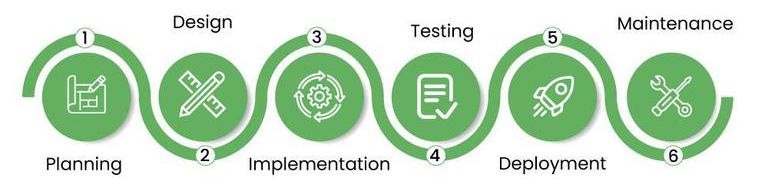
That is why the Software Development Life Cycle (SDLC) was introduced. SDLC helps structure the entire software development process in a scientific manner, from requirements gathering and design to implementation, testing, deployment, and maintenance. A clear understanding of SDLC not only enables development teams to work more effectively but also ensures that the final product meets user requirements.
In this article, you and I will explore SDLC in detail – from its definition and core phases to common development models, practical application, and current trends in the field of software development.
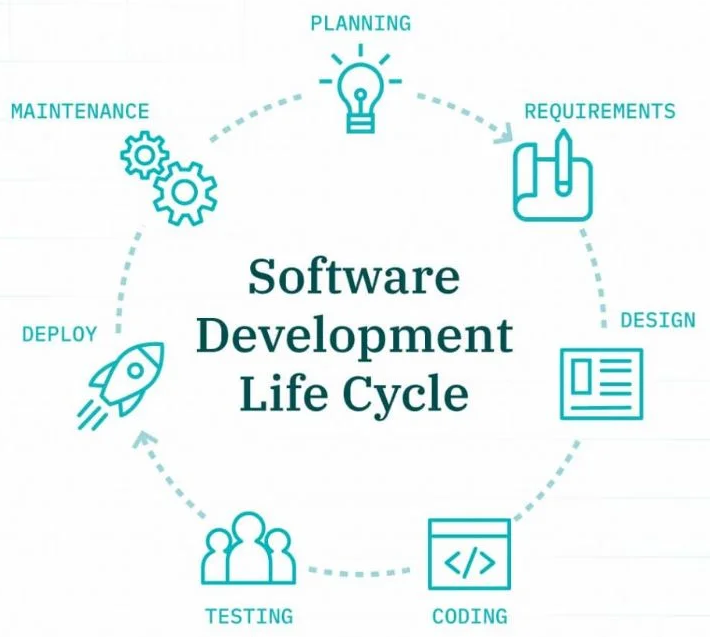
1. Concept of the Software Development Life Cycle (SDLC)
The Software Development Life Cycle (SDLC) is a systematic process that describes the entire journey of creating software, starting from idea formation through deployment and long – term maintenance. The objective of SDLC is to ensure that software meets user requirements, operates reliably, maintains high quality, is scalable, and is delivered on time within acceptable cost constraints.
SDLC serves as an overall guideline for development teams. With a clear framework in place:
- Each team member understands their specific responsibilities at each stage, avoiding overlap and confusion.
- Defined milestones help track progress and evaluate software quality.
- Risks are reduced, as issues can be identified early before the software reaches end users.
- Planning, cost estimation, and resource allocation become more accurate.
Although SDLC cannot eliminate all problems in software development, it functions like a “roadmap,” guiding development teams in the right direction while enabling control over progress and quality. Depending on the nature of the project, organizations may adopt different SDLC models – such as Waterfall, Agile, or Spiral – to achieve optimal results.
2. Main Phases of the Software Development Life Cycle
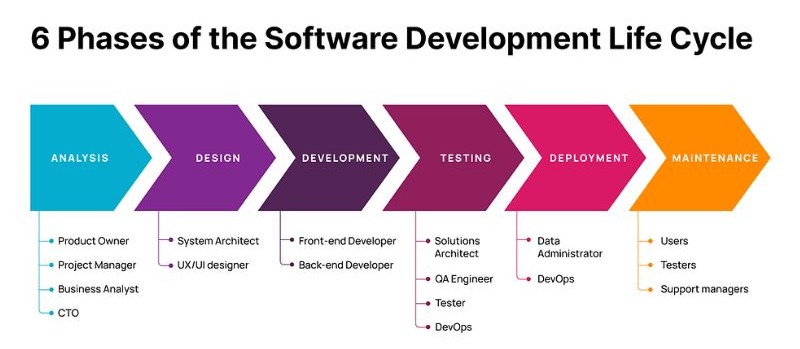
The Software Development Life Cycle (SDLC) is divided into multiple sequential phases, each with clearly defined objectives, specific activities, and identifiable deliverables. Understanding each phase not only helps development teams work with clear direction but also ensures that the development process remains consistent, controllable, and measurable.
2.1. Requirement Analysis Phase
Objective:
To accurately identify the needs of users and stakeholders, clearly understand the problem to be solved, and capture technical, legal, and acceptance constraints as a foundation for subsequent design and development.
Key Activities:
- Requirements gathering: Through interviews, workshops, surveys, or observation of users’ real-world workflows.
- Requirements documentation: Creating a Software Requirements Specification (SRS) or a system of user stories in Agile-based models.
- Requirements classification:
- Functional requirements: Describe what the system must do.
- Non-functional requirements: Include performance, security, usability, scalability, and other quality attributes.
- Requirements validation (sign-off): Presenting and aligning requirements with clients or user representatives to avoid misunderstandings.
Deliverables:
- An approved set of requirements documents, including a prioritized backlog or detailed user stories.
- Quality metrics (KPIs) used to evaluate how well requirements are met.
- A solid foundation for system design and development planning.
Illustrative Example:
For a task management application, functional requirements may include:
- Users can filter tasks by status or tag to track progress.
- Users can create, edit, and delete tasks.
- Each task includes a deadline, status, and classification tags.
2.2. System Design Phase
Objective:
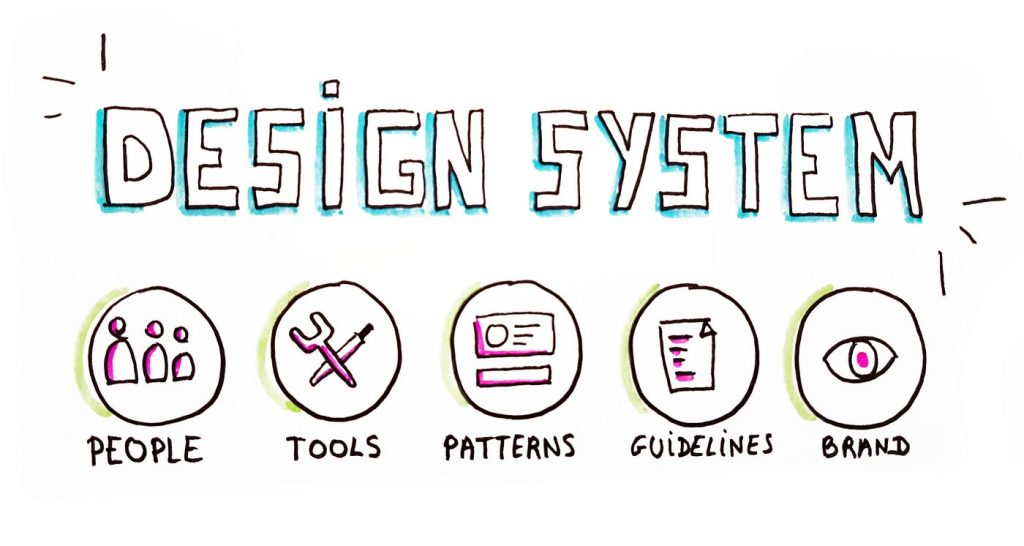
To transform the validated requirements into a detailed technical architecture and system design, answering the question “How will the software work?”. This phase lays the foundation for the entire implementation process, helping the development team clearly understand the system structure and how its components interact with one another.
Key Activities:
- High-Level Design (HLD):
- Define the overall system architecture (e.g., monolithic, microservices, client–server).
- Describe the main components, how they communicate, and the data flow between them.
- Low-Level Design (LLD):
- Detail each module, data structures, API endpoints, and Entity–Relationship Diagrams (ERD) for the database.
- Design the user interface using wireframes or prototypes to illustrate interaction flows.
- Security and Deployment Design:
- Identify data protection mechanisms, access control strategies, and appropriate deployment topologies suited to the real-world environment.
Deliverables:
- A unified technical design package serving as the basis for subsequent implementation, testing, and deployment phases.
- System architecture diagrams, UML diagrams, ERDs, and detailed API documentation.
- UI prototypes or interface models that help visualize the user experience.
2.3. Implementation / Coding Phase
Objective:
To transform the detailed design into executable source code, ensuring correct functionality, performance, and compliance with established technical standards.
Key Activities:
- Writing code in accordance with coding conventions, using clear and meaningful names for variables and functions, and adding comments where necessary.
- Applying unit testing or Test-Driven Development (TDD) to ensure each component functions correctly.
- Using version control systems (e.g., Git) with well-defined workflows such as feature branches and pull requests.
- Conducting code reviews to identify issues early, facilitate knowledge sharing, and maintain high code quality.
- Integrating CI/CD pipelines to automate the build, test, and deployment processes.
Deliverables:
- Complete source code that is well-structured, readable, and maintainable.
- A system that can be successfully compiled and executed in accordance with the design.
- Initial test reports or build/test logs generated from the CI system.
2.4. Software Testing Phase
Objective:
To ensure that the software functions as specified in the defined requirements, remains stable across various scenarios, and does not exhibit critical defects before delivery or deployment.

Key Activities:
- Designing and executing different types of testing:
- Unit Testing: Verifying individual functions or classes to ensure they work correctly in isolation.
- Integration Testing: Validating whether interactions between modules function smoothly.
- System Testing: Evaluating the entire system to ensure it operates according to the overall design.
- Acceptance Testing (UAT): Performed by users or clients to confirm that the software meets real-world requirements.
- Using automated testing tools (such as JUnit, Selenium, Postman) to improve efficiency and consistency.
- Recording and classifying defects, then returning them to the development team for resolution.
Deliverables:
- Test suites executed with a high pass rate.
- Detailed bug reports and test coverage statistics.
- Confirmation that the software meets quality standards and is ready for the deployment phase.
2.5. Deployment Phase
Objective:
To move the software from the development environment to the live environment (staging or production) in a safe, stable, and repeatable manner, ensuring that end users can access and use the product without service disruption.
Key Activities:
- Selecting an appropriate deployment approach:
- Manual Deployment: Commonly used for small projects or internal testing.
- Automated CI/CD Deployment: When code is pushed to the main branch, the pipeline automatically performs build → test → deploy, reducing human error and accelerating release cycles.
- Using containerization technologies: Such as Docker to package applications, combined with Kubernetes for orchestration and scalability in complex environments.
- Applying safe deployment strategies: Such as Blue-Green Deployment or Canary Release to minimize risks when rolling out new versions and enable quick rollback if issues arise.
Deliverables:
- A successfully deployed software version operating stably in the production environment.
- CI/CD systems that automate the build–test–deploy process.
- Deployment logs that support monitoring and evaluation of the release process.
2.6. Maintenance Phase
Objective:
To ensure that the software continues to operate reliably, securely, and efficiently after release. This phase focuses not only on bug fixing but also on improvement, optimization, and adaptation to changes in the environment or user requirements.
Key Activities:
- Performing different types of maintenance:
- Corrective maintenance: Fixing defects discovered during real-world usage.
- Adaptive maintenance: Modifying the software to accommodate changes in the operating environment (e.g., operating system updates, library upgrades, API changes).
- Perfective maintenance: Enhancing performance or adding new features based on user feedback.
- Preventive maintenance: Periodic review and optimization to prevent potential future issues.
- Monitoring system performance and activity logs to detect anomalies.
- Updating technical documentation and user guides whenever changes are made.
Deliverables:
- Software that remains stable over time, minimizing risks and service disruptions.
- Maintenance reports documenting changes, patches, and improvements.
- Regularly updated systems that ensure long-term compatibility, security, and performance.
3. Common Software Development Life Cycle (SDLC) Models
There is no single SDLC model that is “one-size-fits-all” for every project. Each model has its own strengths and limitations, depending on factors such as requirement stability, team size, technical risk, and organizational culture. Below are some representative models that are commonly applied in practice.
3.1. Waterfall Model
Description:
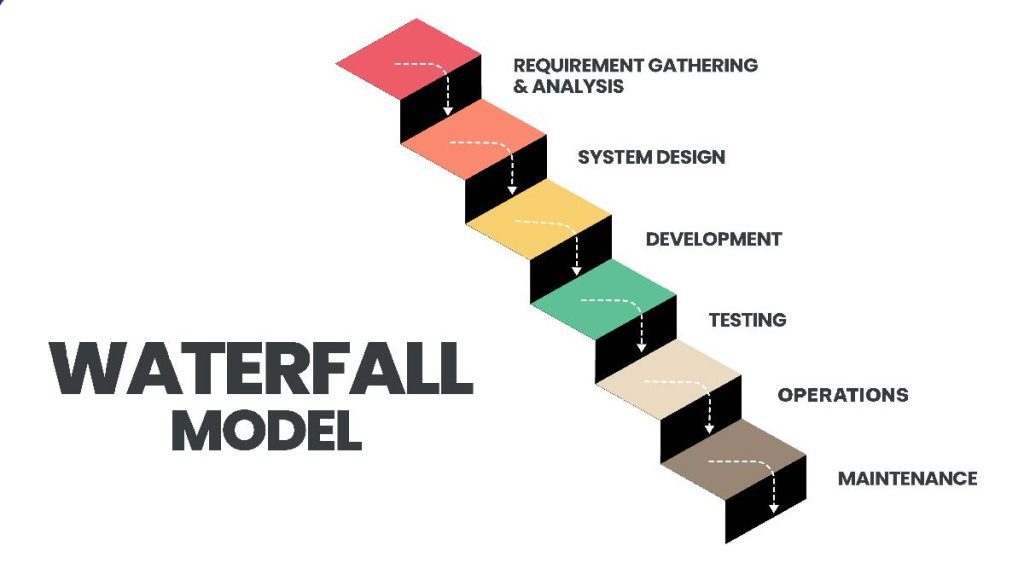
A linear model in which phases are carried out in a fixed sequence: requirements analysis → design → implementation → testing → deployment → maintenance. Each phase must be completed before moving to the next, with little to no iteration or return to previous stages.
Advantages:
- Easy to understand and straightforward to manage in terms of schedule and cost.
- Suitable for projects with clear, well-defined requirements and minimal change.
- Appropriate when detailed documentation and standardized processes are required (e.g., enterprise or government environments).
Disadvantages:
- Lacks flexibility: difficult to accommodate requirement changes mid-project.
- Defects are often discovered late, during testing or deployment phases.
- Not suitable for products that require continuous user feedback.
When to use:
Applied to small projects or projects with stable, clearly defined requirements and low uncertainty.
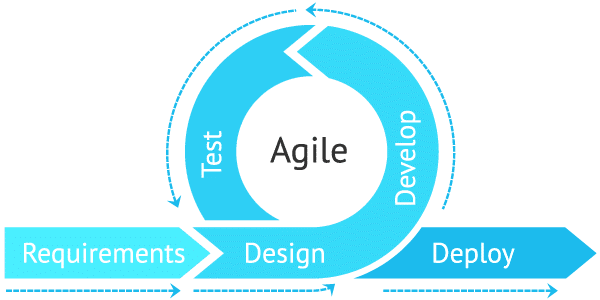
3.2. Agile
Description:
Agile is a flexible, iterative development model that operates in short cycles (iterations/sprints), with a strong focus on rapid user feedback and continuous improvement. Instead of building the entire product at once, the development team and customers collaborate closely to deliver value incrementally.
Advantages:
- Quickly adapts to change.
- Delivers value early and continuously through small, frequent releases.
- Encourages strong collaboration between team members and customers.
Disadvantages:
- Requires high discipline in scope management and communication.
- Inexperienced teams may lose direction or lack alignment.
When to use:
Well suited for innovative projects, startups, or products that require fast user feedback.
Some common Agile frameworks include:
- Scrum: Works in sprints lasting 2–4 weeks, with sprint planning and retrospectives.
- Kanban: Focuses on continuous workflow and optimizing value streams
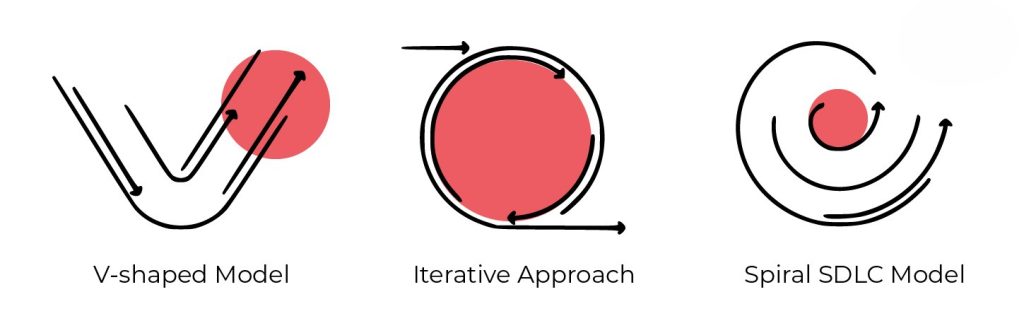
3.3. Spiral, V-Model, và Iterative
Spiral Model:
This model combines iterative development with risk management. The development process proceeds through multiple “spirals,” with each loop consisting of four main steps:
- Defining objectives and requirements.
- Analyzing and evaluating risks.
- Developing and testing prototypes.
- Reviewing results, gathering feedback, and planning the next iteration.
This model is particularly suitable for large, complex projects with high technical uncertainty, such as defense software or systems integrating new technologies.ếu tố kỹ thuật chưa chắc chắn, ví dụ như phần mềm quốc phòng hoặc hệ thống tích hợp công nghệ mới.
V-Model (Verification and Validation):
This model is an extension of the Waterfall model, emphasizing the parallel relationship between development and testing. Each development phase (analysis, design, coding) has a corresponding testing phase (unit testing, integration testing, system testing).
The V-Model is commonly applied in industries that require high reliability and safety, such as aviation, healthcare, or banking, where errors can lead to serious consequences.
Iterative Model:
In this model, software is developed in incremental parts (iterations). Each iteration produces a more complete version of the product, adding new features and optimizing based on user feedback.
This is an effective choice for products that need to be released early and then gradually improved, such as web applications or Software as a Service (SaaS) solutions.
4. Applying SDLC in Practice
In real-world environments, SDLC serves as a “roadmap” for the entire software project. When applied correctly, SDLC helps development teams collaborate more effectively, avoid conflicts, and minimize risks throughout the working process.
Specific Benefits:
- Reduced defects and rework: By clearly defining requirements from the outset and conducting testing throughout the process, development teams can detect issues early and avoid costly fixes later.
- Increased transparency: Clearly managed milestones and deliverables allow stakeholders to easily track progress and provide timely feedback.
- Optimized cost and time: Structured planning and process control help prevent resource waste and ensure that the product meets quality expectations within a reasonable budget.
- Improved productivity: SDLC encourages code reuse, code reviews, and test automation, thereby enhancing the efficiency of technical teams.
In summary, SDLC is not merely a project management theory but a practical framework that supports effective, controlled, and sustainable software development.
5. Current Trends in Software Development
The software industry is evolving rapidly, and the SDLC process is continuously being optimized to meet new demands for speed, quality, and automation. Some notable current trends include:
- Integrating AI into SDLC: Tools such as GitHub Copilot and Tabnine are supporting developers in writing code, detecting errors, and suggesting optimized solutions – helping reduce development time and improve code quality.
- DevOps and CI/CD: The integration of development (Dev) and operations (Ops), together with Continuous Integration / Continuous Deployment practices, automates build, test, and deployment processes. This reduces delays between stages and enables faster responses to change.
- Shift-left testing: Instead of testing only at the final stages, development teams are moving testing earlier in the process, allowing issues to be identified and resolved during the design or coding phases.
- End-to-end automation: From deployment to monitoring, a wide range of automation tools help ensure stable system operation, reduce human workload, and increase product reliability.
Overall, these trends are making SDLC more flexible, efficient, and better aligned with the pace of modern software development.
6. Conclusion
The Software Development Life Cycle (SDLC) is not merely a theoretical model, but a foundation that enables development teams to build products in a systematic, controlled, and efficient manner. When applied correctly, SDLC helps minimize risks, improve software quality, and ensure transparency throughout the development process.
Today, with the integration of AI, DevOps, CI/CD, and modern testing approaches, SDLC has become more flexible than ever – supporting organizations in shortening time-to-market while responding quickly to market and user demands.
Understanding and applying SDLC effectively is a key factor that helps organizations build sustainable, scalable software and maintain a competitive advantage in an era of continuous technological innovation.
7. Reference
[1] I. Sommerville, Software Engineering, 10th ed., Pearson, 2015.
[2] R. S. Pressman and B. R. Maxim, Software Engineering: A Practitioner’s Approach, 9th ed., McGraw-Hill Education, 2019.
[3] IEEE Computer Society, IEEE Std 12207-2017 – Systems and Software Engineering — Software Life Cycle Processes, IEEE, 2017.
[4] K. Beck et al., Manifesto for Agile Software Development, 2001. [Online]. Available: https://agilemanifesto.org/
[5] Atlassian, “What is SDLC? Software Development Life Cycle Phases, Methodologies, and Processes,” [Online]. Available: https://www.atlassian.com/software-development/software-development-life-cycle
[6] GitLab, “DevOps Lifecycle,” [Online]. Available: https://about.gitlab.com/topics/devops/
[7] IBM, “What is SDLC (Software Development Life Cycle)?,” [Online]. Available: https://www.ibm.com/topics/software-development-life-cycle